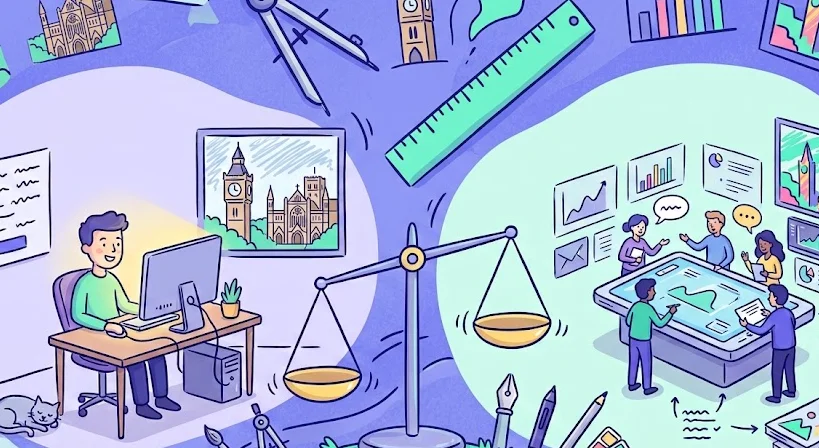

If you run a business in St Albans and need design work done, you’ve got two main routes: hire a freelancer or hire an agency. People assume the agency is the safer, more professional choice and the freelancer is the budget option. The truth is messier and more interesting than that, and it matters even more here, because St Albans sits close enough to London that “just call a London agency” is often the default rather than a considered choice.
I’m a freelance designer working with businesses across St Albans, so you might expect me to talk my own book. I’ll try not to. I’ve worked both sides, in-house and agency early in my career, freelance for years since. There are real reasons to pick an agency, and I’ll be honest about them. Here’s how to actually decide.
The Quick Version
| Factor | Freelancer | Agency |
|---|---|---|
| Cost | Lower, less overhead | Higher, you pay for the team |
| Who does the work | The person you hired | A team, often juniors |
| Communication | Direct, one point of contact | Through an account manager |
| Speed | Usually faster for small jobs | Slower, more process |
| Capacity | Limited to one person | Can handle large, complex projects |
| Range of skills | Specialist, deep in their area | Broad, many disciplines under one roof |
Where Freelancers Win
You work with the person doing the work
This is the big one. When you hire a freelancer, the person you talk to is the person designing. Nothing gets garbled passing through an account manager to a designer and back. You explain what you want once, to the human who’s going to make it.
That direct line tends to produce better work and fewer rounds of “that’s not quite what I meant.”
Lower cost, less overhead
A freelancer doesn’t have a city-centre office, a sales team, or a layer of managers to pay for. You’re paying for the work, not the building. For the same budget, you often get a more senior person actually touching your project, because at an agency that budget might get handed to a junior.
Speed and flexibility
Small jobs move fast with a freelancer. There’s no internal kickoff meeting, no resourcing queue, no process for the sake of process. If you need a quick turnaround and a direct conversation, that’s hard to beat.
Why This Matters More in St Albans
St Albans is unusual for a city its size. It’s affluent, it’s full of independent shops, cafes and professional services around St Peter’s Street and the Cathedral, and it’s a twenty-minute train ride from central London. That last point changes people’s instincts. A lot of St Albans business owners assume that if they want it done properly, they should call a London agency, because London means bigger and bigger means better.
What actually happens is you pay London overheads, a London office, London salaries, sometimes a London account manager who’s never set foot in Hertfordshire, for work a St Albans-based freelancer can do to the same standard without any of that markup. The independent shops and small professional practices that make St Albans what it is rarely have agency-sized problems. They need a logo, a website, some ads that land, done well by someone who actually understands the local market rather than treating it as a satellite of London.
Where Agencies Win
I’m not going to pretend agencies don’t have real strengths, because they do.
Capacity for big, complex projects
If you need a full rebrand rolled out across fifty touchpoints, a campaign that spans print, digital, video and events, all at once and to a tight deadline, a single freelancer can’t physically do that. An agency has the bodies. For genuinely large, multi-discipline work, that capacity matters.
A whole team under one roof
Agencies bring designers, copywriters, developers, strategists and project managers together. If your project needs all of those at once and you don’t want to coordinate several freelancers yourself, an agency handles that for you.
Cover and continuity
A freelancer can get ill, go on holiday, or get booked up. An agency has people to cover. For long-running work where continuity is critical, that’s a fair point in their favour.
The Honest Middle Ground
Here’s what I actually tell people. Most small businesses don’t have agency-sized problems. They need a logo, a website, some ads that work, done well by someone they can talk to directly. For that, a freelancer is usually the better fit on both cost and quality.
You step up to an agency when the scale genuinely demands it: lots of work, lots of disciplines, all at once, with the budget to match.
There’s also a hybrid worth knowing about. A good freelancer often has a small network of trusted people, a developer here, a copywriter there, and can pull them in when a project needs it. You get the direct relationship of a freelancer with some of the capacity of a small team, without the agency overhead. That’s how I work when a project calls for it.
How to Decide
Ask yourself a few honest questions:
- How big is the project, really? One deliverable or fifty?
- How many different skills does it need at once? One specialist or a full team?
- How much do you value talking directly to the person doing the work?
- What’s your budget, and where do you want it going, the work or the overhead?
If your answers point to “fairly contained, want it done well, want to talk to a real person,” that’s a freelancer. If they point to “huge, complex, many disciplines, tight deadline,” that’s an agency.
Whichever you choose, briefing them well makes a massive difference to what you get back. I wrote a guide on exactly that: how to brief a designer. It’ll save you money either way.
What to Ask Before You Hire Either
Whichever way you lean, a few questions save you from a bad fit. Ask any designer or agency these before you commit:
- Can I see work for businesses like mine? A portfolio full of huge brands tells you little about whether they can help a local shop or a startup.
- Who will actually do the work? With an agency, the person who sold you the project often isn’t the one designing it. Ask to meet the designer.
- What exactly do I get? Number of concepts, revision rounds, final file formats, deadlines. Get it in writing.
- How do we communicate? Direct with the designer, or through a manager? How quickly do they reply?
- What does it cost, all in? No surprise extras halfway through.
The answers tell you more than any sales pitch. A good freelancer and a good agency will both answer them straight. Anyone who dodges them is telling you something.
A Quick Word on Cost for St Albans Businesses
If you run a business in St Albans, the maths usually favours a freelancer for the kind of work you need: a logo, a website, ongoing ad design. You get a senior person on the job for a price that doesn’t include a London agency’s overhead or its postcode premium, and you talk to them directly instead of through an account manager. The same logic holds for businesses further up the A5 in Luton, Dunstable and Milton Keynes.
The exception is genuine scale. If you’re rolling out a big campaign across many channels at once, the capacity of an agency earns its fee. Most small businesses aren’t there, and that’s fine. You can always start with a freelancer and step up if you outgrow them. Briefing whoever you pick well makes a big difference to what you get back, so it’s worth reading how to brief a designer before you start.
Working With Me
I’m a freelance designer working with businesses across St Albans, as well as Luton, Dunstable and Milton Keynes. I offer logo and branding, web design and ad design, which for most small and growing St Albans businesses is everything you need from one person who actually picks up the phone, no train fare to London required.
If you want to talk through whether a freelancer is right for your project, even if the honest answer turns out to be “you need an agency for this one,” I’ll tell you straight. Initial chats are free and there’s no obligation, and I reply to every enquiry within a day.
Send me a message, email me@louislantos.com, or call 01582 206160.